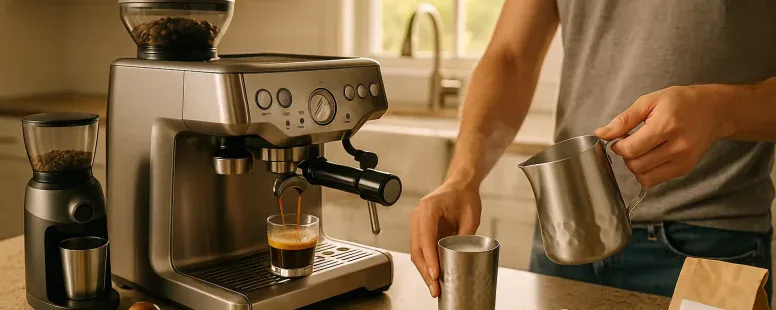
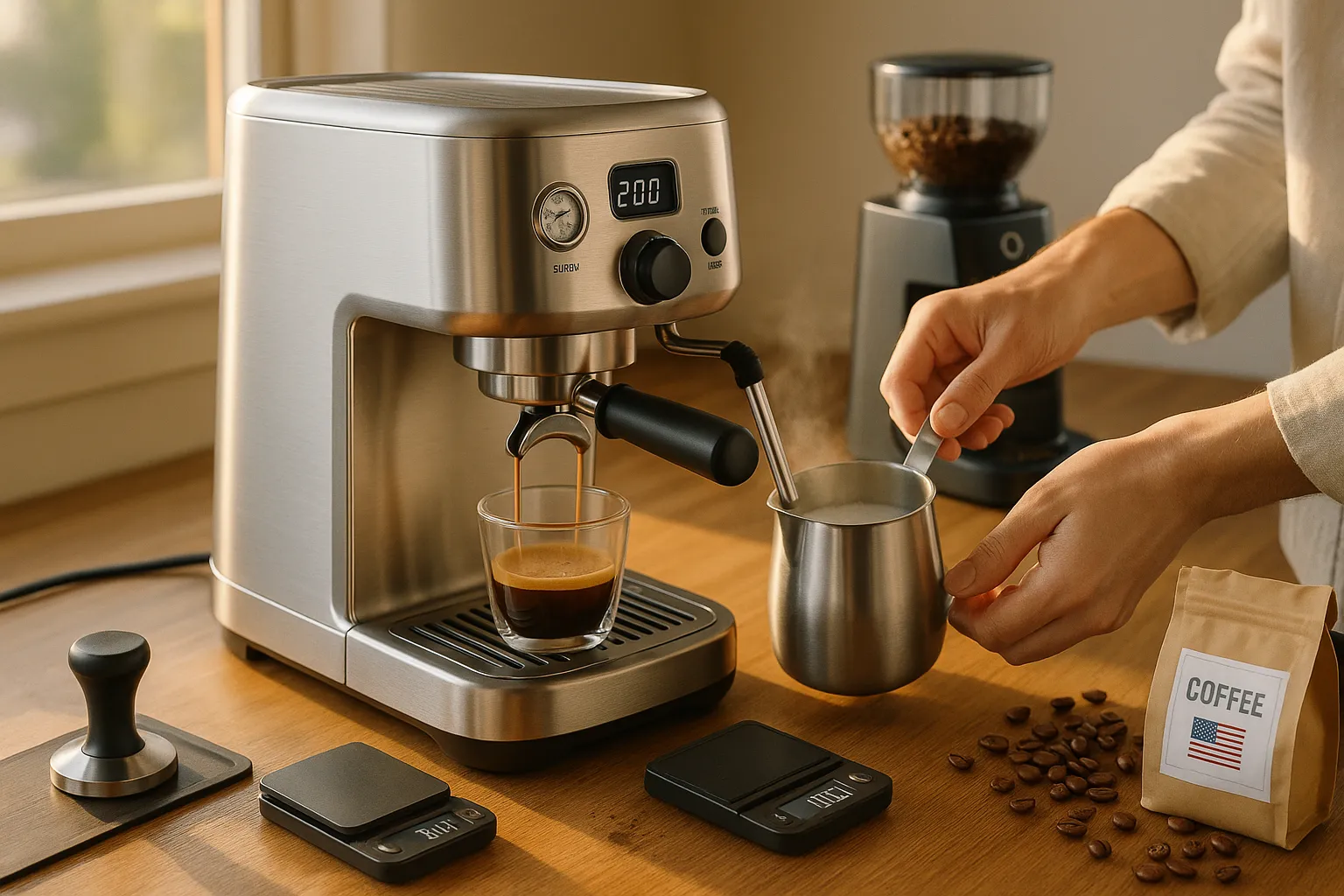
You can get café-style espresso at home without emptying your wallet or learning barista-level wizardry. The best beginners espresso machine gives you consistent shots, a forgiving workflow, and room to grow. Picture the hiss of a steam wand and the citrus-bright crema on a double shot, that experience is within reach. This guide explains what matters in an entry-level machine, shows clear options by use case, and gives practical tips so your first ten shots taste great. Read on and you’ll know which machine fits your life, budget, and taste.
Why Choose An Entry‑Level Espresso Machine
Fact: an entry-level espresso machine lowers the learning curve while delivering real espresso. You want reliable temperature, decent pressure, and simple controls. Entry-level models save you time and money because they include necessary basics, pump, portafilter, and a steam wand, without the complexity of commercial parts.
Context: For many beginners, the goal is twofold: taste and routine. You want shots that taste clean and repeatable, and a routine you can repeat each morning. Machines from brands like Breville, Gaggia, De’Longhi, and Rancilio offer that bridge. They give you manual control when you want it, but don’t punish small mistakes.
Why this matters: Starting on a forgiving machine keeps you brewing. If your first months are full of frustrating pulls, you will likely stop. A good entry-level machine helps you learn grind size, dose, and tamping step by step, and it grows with you as your skill improves.
Key Features To Look For
Fact: focus on pump type, temperature stability, grinder setup, steam quality, and ease of use. Each controls shot quality and the time you spend on upkeep.
Grouphead And Pump Type
Insight: A 15–18 bar vibratory pump is standard and good for beginners. Rotary pumps exist but cost more and suit professional setups. The grouphead should be solid and chrome-plated: E61 style groupheads give steady temperature but add cost. Most beginner machines use a pressurized or non-pressurized portafilter. Pressurized portafilters help on inconsistent grinders, but you sacrifice some control.
Boiler And Temperature Stability
Insight: Single-boiler machines heat brew water and steam sequentially. Heat-exchange or dual-boiler systems keep brew temperature more stable but cost more. For starting out, a single boiler with PID or electronic temperature control is usually best. PID adds repeatability and is worth the extra money.
Built‑In Grinder Vs. Separate Grinder
Insight: Built-in grinders add convenience but often compromise grind consistency. If you care about peak espresso flavor, buy a separate burr grinder from Baratza, Eureka, or Mazzer (refurbished models are fine). If convenience wins, choose an integrated bean-to-cup machine from Jura or De’Longhi.
Steam Wand Quality And Milk Texturing
Insight: A quality steam wand makes creamy microfoam possible. Look for a stainless steel, commercial-style wand with good steam pressure and a frothing tip. Automatic milk systems are convenient, but they limit technique learning.
Ease Of Use And Cleaning
Insight: Removable water tanks, accessible drip trays, and straightforward descaling routines matter. Machines with clear indicator lights, simple buttons, and a few removable parts will make maintenance painless. You will clean daily and descale monthly depending on water hardness.
Top Beginner Espresso Machines (Recommended Picks)
Fact: different beginners have different priorities, control, convenience, budget, or growth. Below are clear picks matched to those needs.
Compact Semi‑Automatic Machine, Balance Of Control And Simplicity
Recommendation: Breville Barista Express (or Sage Barista Express in some markets). It combines a quality burr grinder and a semi-automatic group that lets you control dose and tamp. The integrated grinder reduces extra purchases and the machine includes a steam wand that textures milk well. You will learn extraction and still get consistent shots. A drawback: the built-in grinder is not as consistent as a dedicated grinder, but it’s excellent for starting out.
All‑In‑One Bean‑To‑Cup Option, Convenience With Good Espresso
Recommendation: Jura A1 or De’Longhi Magnifica S. These machines grind, dose, tamp, and brew automatically. They deliver repeatable espresso with minimal fuss. Choose this if you want barista-style drinks in under a minute and value daily convenience over full manual control.
Budget Manual/Lever‑Style Option, Learn The Basics (Low Cost)
Recommendation: Flair Classic or a refurbished La Pavoni. These lever machines give direct mechanical control of pressure and extraction. They teach you how pressure and timing affect flavor. They lack a built-in boiler or automatic steam, so you’ll need a separate kettle or frother. They cost less but demand more effort.
Entry‑Level Prosumer Machine, For Fast Growth And Skill Development
Recommendation: Rancilio Silvia or Gaggia Classic Pro paired with a Baratza Encore grinder. These machines have better boilers, durable parts, and serviceable components. They require a separate grinder but reward you with higher-quality shots and a clear path to skill growth. They also hold value if you later trade up.
How To Choose Based On Your Needs
Fact: match the machine to your habits, space, and long-term costs. The right choice minimizes regret.
Your Coffee Habits And Drink Preferences
Insight: If you drink mostly americanos or straight shots, a simple semi-automatic is enough. If you make milk drinks daily, prioritize a strong steam wand or an automatic milk system. If you host friends often, choose a machine with fast heat recovery or dual boilers.
Kitchen Space, Workflow, And Footprint
Insight: Measure your counter and think workflow: grinder next to machine, cup space, and milk pitcher clearance. Compact machines like the Breville Barista Express fit small counters: machines with bean hoppers or water reservoirs need more room.
Long‑Term Costs: Beans, Grinder, And Maintenance
Insight: Expect to spend on a quality burr grinder, fresh beans, and replacement parts (gaskets, filters). Beans cost more if you pick specialty roasters like Stumptown, Intelligentsia, or local roasters. Plan for $20–40/month on beans if you drink espresso regularly.
Durability And Serviceability, Parts, Warranty, And Repairs
Insight: Choose brands with local service centers or available spare parts. Rancilio and Gaggia have long track records: Breville offers good warranty support in many countries. Refurbished prosumer machines can be a smart buy if a trusted technician inspects them.
Beginner Brewing And Maintenance Tips
Fact: good shots come from consistent routine and basic maintenance. The same five steps repeated give the best results.
Making Your First 10 Shots, Simple Step‑By‑Step Routine
Heat: Turn the machine on and let it warm for 15–20 minutes. PID machines need less time.
Grind: Use a medium-fine espresso setting. Start with 18–20 grams for a double dose.
Dose & Tamp: Distribute grounds, then tamp with even pressure (20–30 lbs). Keep the puck level.
Pull: Start extraction and time it. Aim for 25–30 seconds for 36–40 ml (double). Adjust grind finer if shot runs too fast.
Taste & Adjust: If bitter, lower brew time or grind coarser. If thin, grind finer or increase dose.
Do this for ten shots and you will find a setting that works. Keep notes.
Basic Milk Texturing For Cappuccinos And Lattes
Fact: position the steam wand near the surface for froth, then lower for microfoam. Stretch milk by keeping the pitcher at a slight angle and introducing air for 2–4 seconds. Then submerge tip to heat to about 60–65°C (140–150°F). Practice on whole milk: it’s more forgiving.
Daily, Weekly, And Monthly Cleaning Checklist
Fact: routine cleaning prevents off-flavors and breakdowns.
Daily: purge steam wand, backflush with water, empty drip tray.
Weekly: backflush with detergent if machine supports it, clean portafilter baskets, wipe grouphead gasket.
Monthly: deep clean the steam wand, replace water filter, inspect group seals.
When And How To Descale Or Replace Seals
Fact: descale based on water hardness and machine instructions. Use a manufacturer-recommended descaler. Replace seals after leaks appear or every 2–3 years on heavy use. If you see brown buildup or slower flow, descale sooner. Keep spare gaskets and a basic tool kit for quick repairs.
Budget, Where To Buy, And Value Considerations
Fact: price correlates with control, durability, and parts availability. Know what each tier gives you.
Price Tiers And What To Expect At Each Level
Insight: Entry-level ($150–$400) gives basic espresso with some automation: expect plastic parts and limited steam power. Mid-range ($400–$1,000) adds metal boilers, PID controls, and better steam. Prosumer ($1,000+) gives dual boilers, serviceable parts, and commercial-grade components. Buy to the level you’ll use: don’t overspend for features you won’t touch.
New Vs. Refurbished: Pros, Cons, And Buying Tips
Insight: New machines give warranty and predictable condition. Refurbished machines, especially prosumer models like Rancilio Silvia or older E61-group machines, give better parts for less money if serviced by a reputable shop. When buying refurbished, ask for a parts list, service records, and a short warranty. Buy from local dealers when possible so you can get parts and repairs fast.
Where to buy: major retailers, authorized dealers, and specialty coffee shops. For beans and grinders, check Baratza, Fellow, and local roasters. For all-in-one convenience, look at Jura dealers for service plans. If you buy online, read return policies and warranty coverage carefully.
Call-to-action: Decide which category fits your mornings, then pick one machine from the matching list and commit to ten consistent shots, practice will pay off.
To provide the best experiences, we use technologies like cookies to store and/or access device information. Consenting to these technologies will allow us to process data such as browsing behaviour or unique IDs on this site. Not consenting or withdrawing consent, may adversely affect certain features and functions.
Functional
Always active
The technical storage or access is strictly necessary for the legitimate purpose of enabling the use of a specific service explicitly requested by the subscriber or user, or for the sole purpose of carrying out the transmission of a communication over an electronic communications network.
Preferences
The technical storage or access is necessary for the legitimate purpose of storing preferences that are not requested by the subscriber or user.
Statistics
The technical storage or access that is used exclusively for statistical purposes.The technical storage or access that is used exclusively for anonymous statistical purposes. Without a subpoena, voluntary compliance on the part of your Internet Service Provider, or additional records from a third party, information stored or retrieved for this purpose alone cannot usually be used to identify you.
Marketing
The technical storage or access is required to create user profiles to send advertising, or to track the user on a website or across several websites for similar marketing purposes.