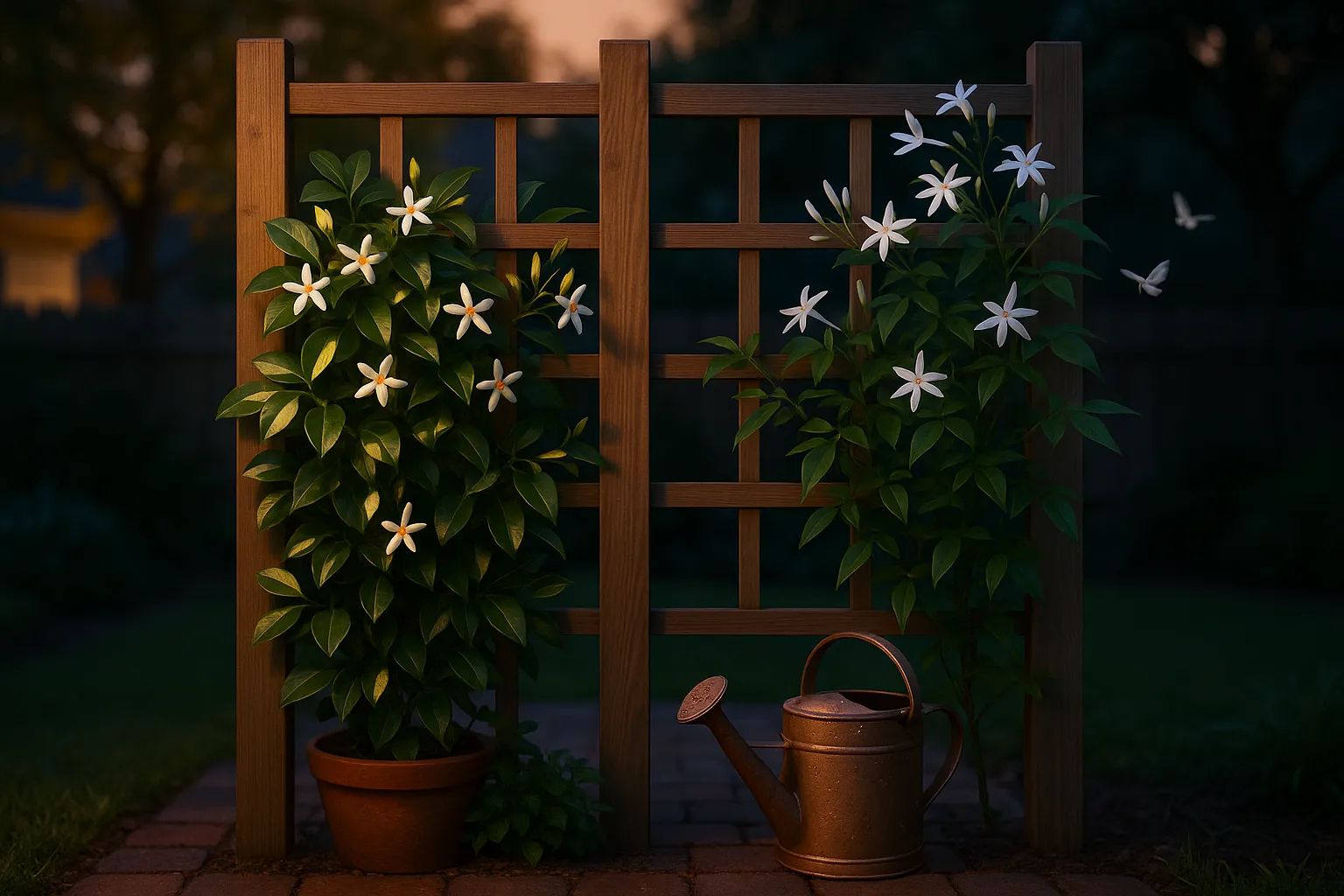
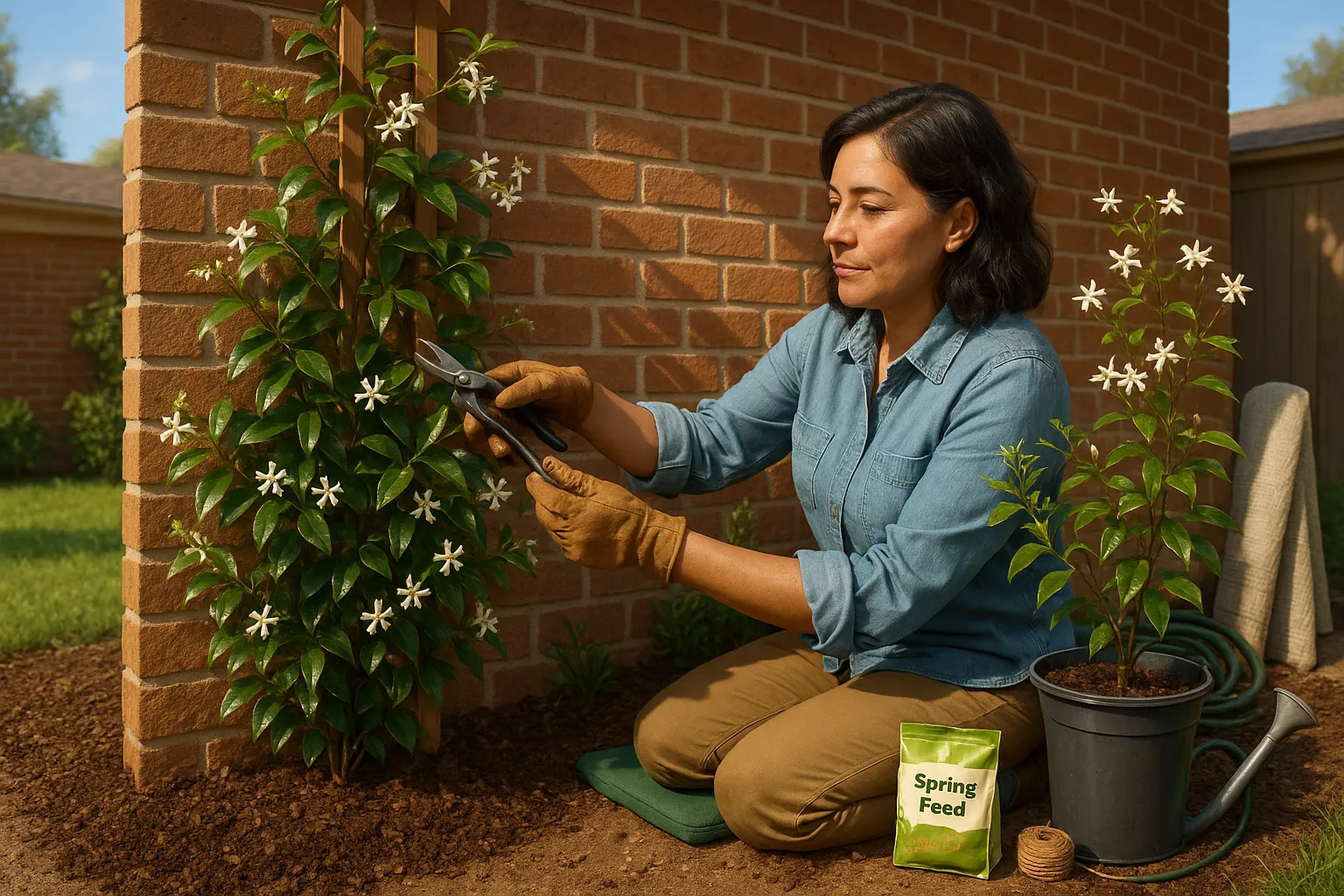
You can choose a vine that scents your porch in spring, or one that climbs a trellis with big, floral clusters. Trachelospermum jasminoides (star jasmine) and common jasmine (usually Jasminum officinale) both offer glossy leaves and sweet perfume, but they behave and smell very differently. Close your eyes: one perfume is creamy and tea-like: the other is sugary and bright. This article compares Trachelospermum vs. Common Jasmine so you can pick the right climber for your yard, patio, or balcony. Expect clear contrasts on growth, scent, maintenance, and how each performs around pollinators.
Quick Comparison At A Glance
Fact: Trachelospermum and common jasmine differ most in scent, leaf form, and growth habit.
Trachelospermum jasminoides (star jasmine)
Form: Evergreen, twining to scrambling vine or dense groundcover.
Leaves: Thick, glossy, opposite leaves: sometimes variegated in cultivars such as ‘Variegatum’.
Flowers: Small, five-pointed white flowers that open in late spring to summer.
Fragrance: Warm, honeyed, tea-like scent that is steady but not overpowering.
Hardiness: USDA zones 8–10 (often grown in pots farther north).
Jasminum officinale (common jasmine) and related Jasminum spp.
Form: Deciduous or semi-evergreen twining vine depending on climate.
Leaves: Compound leaves (usually 3–7 leaflets), lighter and thinner than Trachelospermum.
Flowers: Clustered tubular white flowers, bloom in summer and sometimes into fall.
Fragrance: Intense, sweet, traditional ‘jasmine’ scent, floral and strongly heady at night.
Hardiness: USDA zones 7–10 for J. officinale: varies with species.
Uses: Pergolas, arbors, screens, climbers for pollinator-attracting plantings.
Quick take: pick Trachelospermum when you want steady evergreen structure and a gentler scent: pick common jasmine when you want a powerful night perfume and a classic jasmine look.
Appearance And Flower Characteristics
Fact: Leaves and flower structure give the fastest clues to which vine you have.
Leaf Shape And Foliage Differences
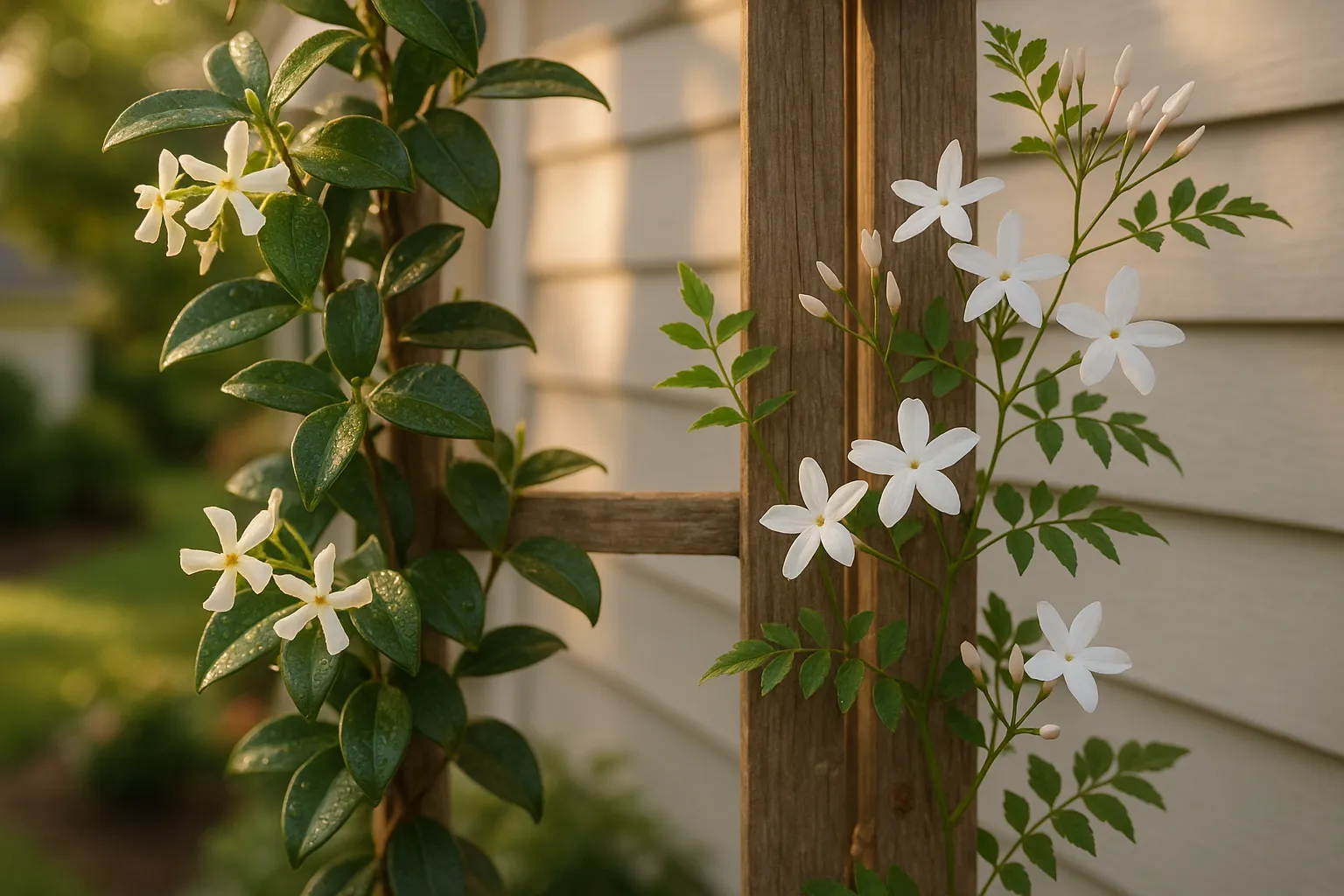
Trachelospermum has simple, opposite leaves. The leaves are ovate, glossy, and often thick: they hold water and look evergreen year-round in mild climates. In contrast, common jasmine (Jasminum officinale) has pinnate leaves made of several small leaflets. The compound leaves give Jasminum a lacy, lighter texture. You will notice that Trachelospermum can be variegated (showing cream margins) while most common jasmine is plain green. This difference alone changes how each vine reads in a garden: Trachelospermum reads dense and structural: Jasminum reads airy and floral.
Flower Form, Color, And Blooming Season
Trachelospermum flowers are star-shaped with five petals. They appear singly or in small clusters and open in late spring through summer. The flowers are pure white or cream and can persist for weeks in good weather. Common jasmine flowers are tubular with flared lobes and usually form in clusters. Jasminum blooms often peak mid- to late summer and can rebloom into early fall in warm areas. The color for both is typically white, but the proportions and arrangements change how gardens feel: Trachelospermum gives a repeated small-note bloom, while Jasminum offers bold floral clusters.
Fragrance And Pollinator Appeal
Fact: The two plants attract different pollinators because their fragrances and flower shapes differ.
Scent Profile And Intensity
Trachelospermum scent is moderate and warm. People describe it as honeyed, with green-tea undertones. The smell spreads across a small patio without overwhelming you. Common jasmine scent is stronger, sweeter, and more narcotic. It throws scent far into the evening, which many gardeners prize. If you want a scent that greets you at the gate, choose Jasminum. If you want subtle evening perfume or a scent that won’t compete with other scented shrubs, choose Trachelospermum.
Attraction To Bees, Butterflies, And Night Pollinators
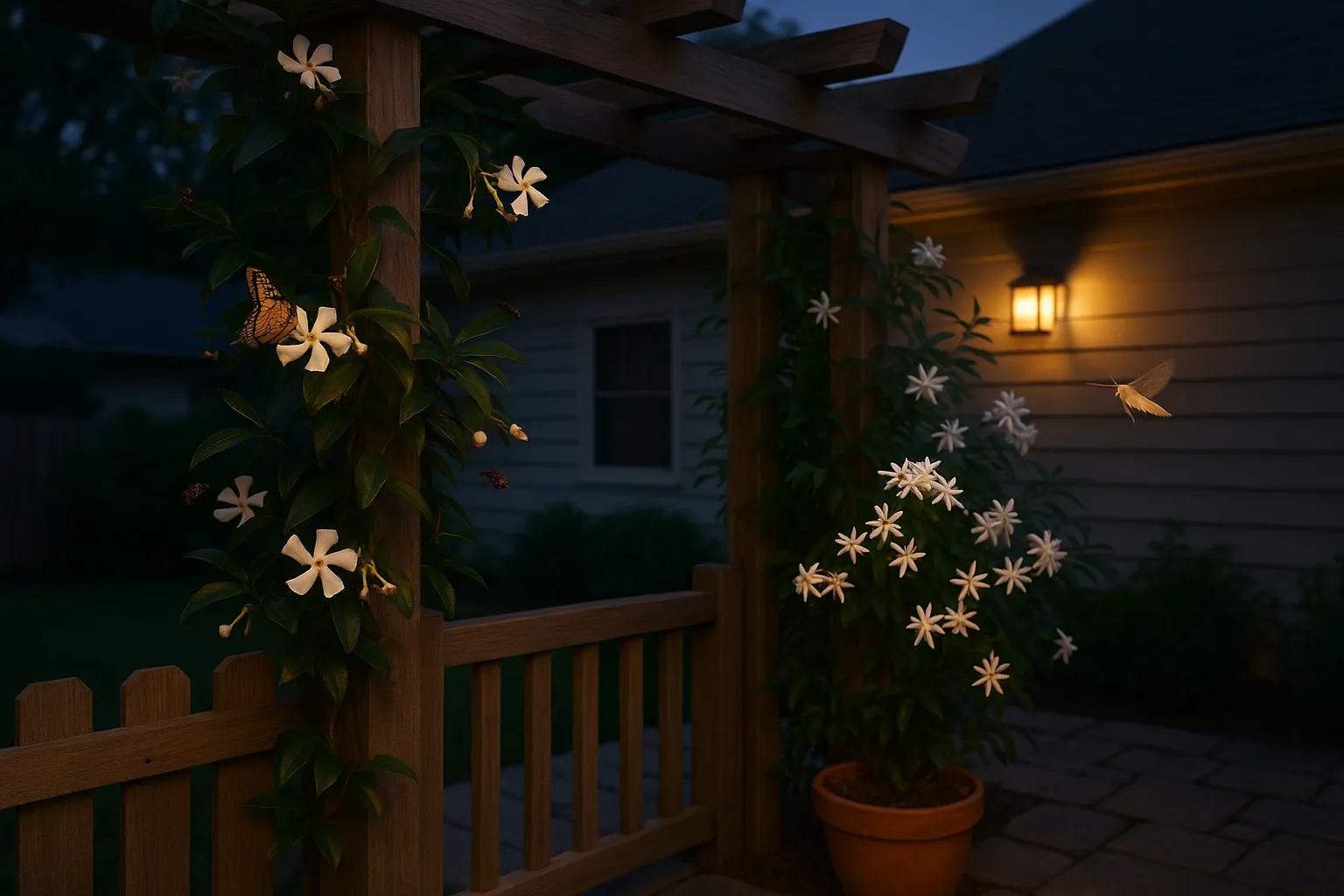
Trachelospermum attracts bees and some butterflies during daylight hours. Its flower shape suits bees that can land and access nectar easily. Common jasmine, with its tubular flowers and potent night perfume, draws moths and evening-active pollinators plus to daytime insects. Hummingbirds may visit some jasmine species, though they prefer tubular red flowers: still, you will see more nocturnal visitors around Jasminum. Both vines support pollinators, but they do so at different times and with different intensity.
Growth Habit And Landscape Uses
Fact: Trachelospermum is slower and more controlled: common jasmine can be faster and more vigorous under the right conditions.
Vigor, Size, And Training As Vines Or Groundcover
Trachelospermum grows steadily to 10–15 feet when trained on supports and can form a dense 2–3 foot groundcover if allowed to sprawl. It twines loosely and anchors with short, twining stems. Common jasmine can reach 15–30 feet in height when it has a structure to climb. It twines tightly and will search for supports, sometimes overrunning smaller plants. You should expect Jasminum to require more space and occasional restraint.
Common Uses In Gardens, Containers, And Mixed Borders
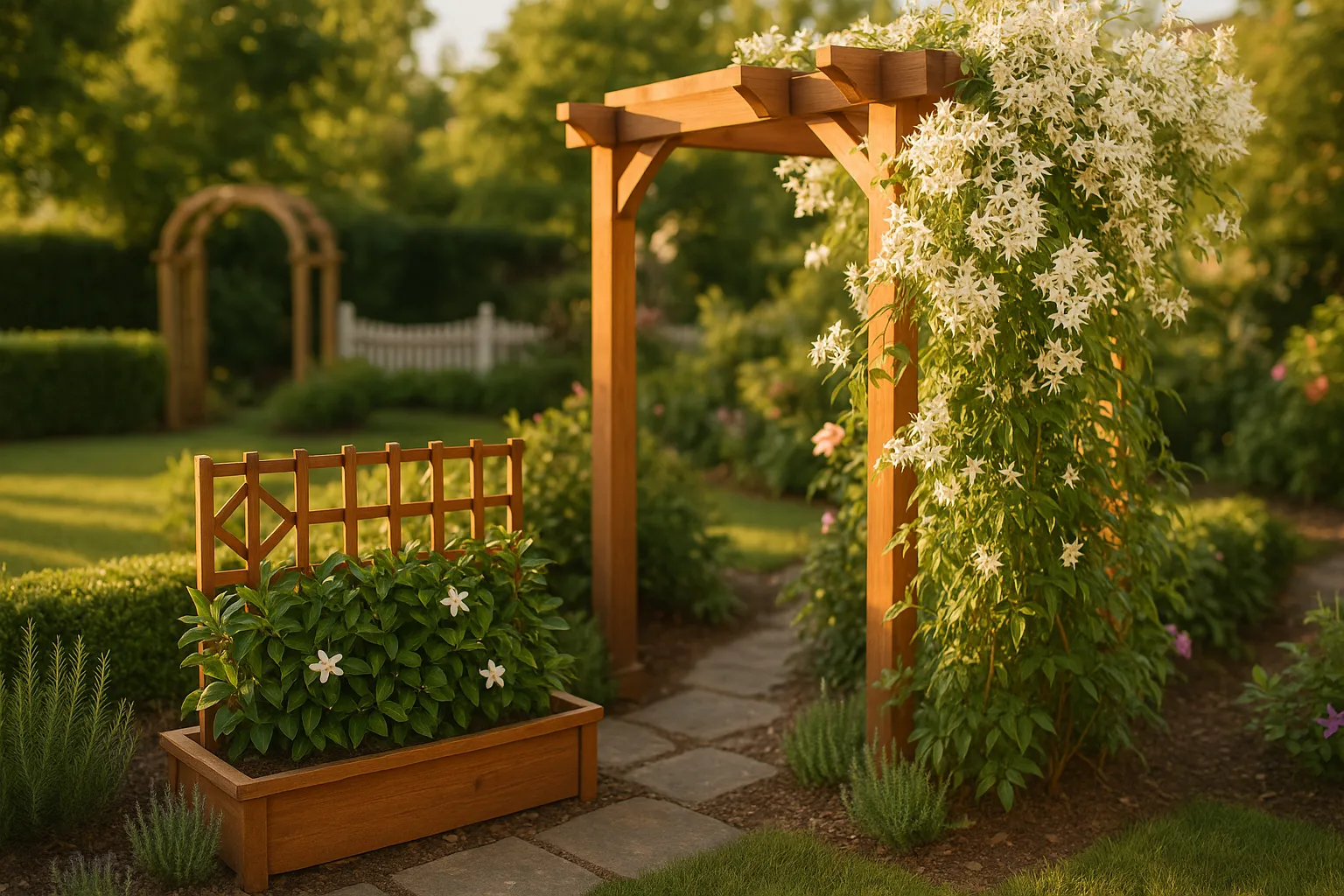
Use Trachelospermum on low trellises, as an evergreen backdrop, or in containers where you want year-round foliage. It pairs well with lavender, rosemary, and boxwood. Use common jasmine on pergolas, arbors, or taller trellises where you want dramatic summer scent. It pairs well with roses, clematis, and summer-flowering shrubs. For mixed borders, trachelospermum gives structure: jasminum gives seasonal drama.
Cultivation And Care Requirements
Fact: Light, soil, and water needs overlap but differ in cold tolerance and pruning needs.
Light, Soil, And Water Needs
Trachelospermum prefers full sun to part shade and well-drained soil. It tolerates some drought once established. Common jasmine also likes full sun for best flowering but tolerates more shade, especially in hot climates. Both prefer neutral to slightly alkaline soils but will adapt to a range of pH if drainage is good. Water both regularly until they root well: then reduce frequency for Trachelospermum and keep moderate moisture for Jasminum during bloom.
Hardiness Zones And Microclimate Considerations
Trachelospermum is reliably hardy in USDA zones 8–10. In cooler zones you can grow it in pots and move it to a sheltered spot in winter. Jasminum officinale is hardy to zone 7 and sometimes into zone 6 with protection. Microclimates matter: plant on south-facing walls to increase warmth, or use windbreaks to protect delicate stems. Frost can damage blossoms and new shoots on both plants, but Jasminum’s spring growth can be more frost-sensitive.
Pruning, Fertilizing, And Overwintering Tips
Prune Trachelospermum lightly after flowering to shape and remove dead wood. Feed annual slow-release fertilizer in spring. For winter, mulch the root zone in cooler areas. Prune common jasmine after its main bloom to control size and encourage new flowering wood. Feed with a balanced fertilizer in early spring and mid-summer. In cold winters, wrap potted jasmines and move them inside or to a frost-free garage.
Pests, Diseases, And Troubleshooting
Both plants are relatively pest-resistant. Watch for scale, aphids, and spider mites on stressed plants. Root rot can occur in poorly drained soils. Jasminum sometimes gets fungal leaf spots: Trachelospermum can show chlorosis in acidic soils. Treat pests with insecticidal soap and improve air circulation to reduce fungal issues. If growth slows, check soil pH and drainage first.
Propagation, Establishment, And Maintenance
Fact: Cuttings establish quickly for both: layering and seed are alternatives with different success rates.
Propagation Methods: Cuttings, Layering, And Seed
Take semi-ripe cuttings of Trachelospermum in late summer: they root readily in a light mix with bottom heat. Jasminum cuttings root easily too, especially softwood cuttings in spring. Layering works well for both: peg a long cane to the soil and wait for roots to form. Seeds are less common because seedlings may not come true to cultivar and take longer to flower.
Establishing New Plants And Ongoing Maintenance Tasks
Plant both vines in spring or fall for best establishment. Space root balls slightly above native soil grade and water deeply for the first season. Mulch to conserve moisture and suppress weeds. Ongoing tasks include training new shoots, annual pruning, and periodic fertility checks. For trachelospermum, rake out crowded stems to keep air moving: for jasminum, tie in new leaders to encourage upright growth. Both benefit from staking early while they form their framework.
Choosing Between Trachelospermum And Common Jasmine
Fact: Choose by scent intensity, evergreen needs, and how much space you can give the plant.
Pros And Cons For Different Garden Goals
Trachelospermum pros: evergreen structure, low-to-moderate scent, good container performance, lower maintenance. Cons: smaller, less dramatic bloom display.
Common jasmine pros: powerful fragrance, bold floral clusters, strong summer presence. Cons: can be more vigorous and require heavy pruning: may die back in colder winters.
If you want low fuss and year-round greenery, go with Trachelospermum. If you want the classic night-scented jasmine experience and have room to manage vigor, choose Jasminum.
Design Recommendations And Plant Pairings
Pair Trachelospermum with Mediterranean plants, olive trees, rosemary, and artemisia, for a quiet, durable composition. Use it as an evergreen backdrop for spring bulbs. Pair common jasmine with summer bloomers like roses, hibiscus, or tall salvias to create a showy, scented arbor. For containers, choose Trachelospermum on small terraces and Jasminum on large planters or trained up obelisks. Consider scent layering: plant a Trachelospermum at eye level and Jasminum overhead on a pergola so scents blend rather than clash.
To provide the best experiences, we use technologies like cookies to store and/or access device information. Consenting to these technologies will allow us to process data such as browsing behaviour or unique IDs on this site. Not consenting or withdrawing consent, may adversely affect certain features and functions.
Functional
Always active
The technical storage or access is strictly necessary for the legitimate purpose of enabling the use of a specific service explicitly requested by the subscriber or user, or for the sole purpose of carrying out the transmission of a communication over an electronic communications network.
Preferences
The technical storage or access is necessary for the legitimate purpose of storing preferences that are not requested by the subscriber or user.
Statistics
The technical storage or access that is used exclusively for statistical purposes.The technical storage or access that is used exclusively for anonymous statistical purposes. Without a subpoena, voluntary compliance on the part of your Internet Service Provider, or additional records from a third party, information stored or retrieved for this purpose alone cannot usually be used to identify you.
Marketing
The technical storage or access is required to create user profiles to send advertising, or to track the user on a website or across several websites for similar marketing purposes.