
Hebe Wiri Cloud Vs. Red Edge: Feature, Performance, And Cost Comparison
You need a clear choice between Hebe Wiri Cloud and Red Edge when your project, budget, or compliance rules demand a platform that fits. Both products promise modern cloud capabilities, but they take different paths. This article places the facts first: what each platform is, how they compare on features, how much they cost over time, and which one likely wins for your situation. Expect specific examples, vendor questions you should ask, and a pilot checklist so you can judge them side‑by‑side.
What Each Platform Is And Who It Serves


Hebe Wiri Cloud, Core Purpose And Target Users
Hebe Wiri Cloud is a cloud-native platform built for rapid application delivery and data workflows. It targets product teams, mid-size SaaS companies, and IT groups that want a managed platform with low operational overhead. Hebe Wiri emphasizes a modular microservices architecture, built-in CI/CD pipelines, and integrations with AWS, Google Cloud, and Azure. Named entities include Hebe Technologies (vendor), Amazon Web Services (AWS), and GitHub Actions.
Hebe Wiri serves teams that want to move fast. It offers preconfigured stacks for Node.js, Python, and Java. You get managed databases, container hosting, and a visual workflow editor. The platform reduces infrastructure setup time, but you trade some low-level control for convenience.
Red Edge, Core Purpose And Target Users
Red Edge is a hybrid cloud platform focused on performance, observability, and enterprise-grade security. It serves large enterprises, regulated industries (financial services, healthcare), and organizations that require fine‑grained policy controls. Red Edge integrates with existing on‑prem systems, VMware, and private clouds, and names like Red Edge Inc., Splunk, and Okta appear in reference architectures.
Red Edge aims at teams that must meet strict SLAs and compliance. It provides deep telemetry, custom networking topologies, and role‑based access control (RBAC) at scale. If you need deterministic performance and strong audit trails, Red Edge positions itself as the safer choice.
Key Feature Comparison


Architecture, Deployment Options, And Hosting
Fact: Hebe Wiri Cloud is cloud‑native and fully managed: Red Edge supports hybrid and on‑prem deployments. Hebe runs primarily on public cloud providers with managed containers and serverless options. Red Edge offers appliances, private cloud modules, and a hosted service. If you require on‑site data residency, Red Edge gives you that option. Hebe simplifies ops through managed services.
Data Management, Storage, And Backup
Fact: Hebe Wiri favors managed cloud databases and object storage: Red Edge provides more storage choices and tiering for compliance. Hebe includes automated backups, point‑in‑time recovery, and connectors for S3 and BigQuery. Red Edge adds encrypted NAS, immutable snapshots, and cold storage for long retention, helpful for legal holds. Real example: a healthcare customer used Red Edge to meet seven‑year retention policies with encrypted cold archives.
Security, Compliance, And Privacy Controls
Fact: Red Edge focuses heavier on enterprise security controls: Hebe Wiri covers standard cloud security well. Red Edge ships advanced features like FIPS 140‑2 modules, dedicated HSM integration, and fine RBAC with attribute‑based access. Hebe Wiri implements SOC 2 and supports single sign‑on (SSO) with Okta and Azure AD. If you must meet HIPAA or PCI DSS, both vendors can help, but Red Edge often provides deeper audit evidence and on‑prem options.
Integrations, APIs, And Extensibility
Fact: Hebe Wiri provides developer‑friendly APIs and many out‑of‑the‑box integrations: Red Edge emphasizes enterprise connectors and customization. Hebe Wiri exposes REST and GraphQL endpoints, and offers SDKs for common languages. Red Edge supplies integration adapters for SAP, legacy databases, and mainframes. You get more low‑level hooks with Red Edge, while Hebe speeds up application development with templates.
Scalability, Performance, And Reliability
Fact: Hebe Wiri scales elastically in public clouds: Red Edge scales predictably across hybrid setups. Hebe autos-scales workloads and is cost‑effective for bursty traffic. Red Edge supports reserved capacity and network optimizations for consistent latency. For throughput tests, a mid‑sized e‑commerce customer saw Hebe handle sudden spikes with auto‑scale, but Red Edge kept tail latency lower during sustained heavy loads.
User Experience, Admin Tools, And Reporting
Fact: Hebe Wiri prioritizes developer UX: Red Edge focuses on operational control and reporting. Hebe delivers a slick web console, CLI, and prebuilt dashboards for deployments. Red Edge gives advanced observability dashboards (Elasticsearch, Grafana), policy management, and detailed audit logs. Admins who like simplicity choose Hebe, while security teams prefer Red Edge’s reporting depth.
Pricing, Licensing, And Total Cost Of Ownership


Pricing Models And Licensing Differences
Fact: Hebe Wiri uses usage‑based pricing: Red Edge uses subscription and appliance licensing. Hebe charges for compute, storage, and managed services with pay‑as‑you‑go billing. Red Edge sells yearly subscriptions, optional hardware, and enterprise support tiers. If you want predictable monthly spend for a large deployment, Red Edge’s subscription can be easier to forecast. If you want to start small and grow, Hebe’s usage model lowers initial cost.
Hidden Costs, Add‑Ons, And Long‑Term TCO
Fact: Long‑term costs depend on scale, data egress, and managed services. With Hebe, hidden costs often come from data egress and managed database scaling. With Red Edge, hidden costs arise from hardware refreshes, dedicated support, and advanced security modules. Example: a finance firm estimated a higher five‑year TCO on Hebe once continuous high‑throughput analytics and egress to BI tools were included. Conversely, another firm found Red Edge’s higher upfront price paid off by avoiding cloud egress fees and giving tighter performance guarantees.
Implementation, Migration, And Support

Onboarding, Deployment Timeline, And Complexity
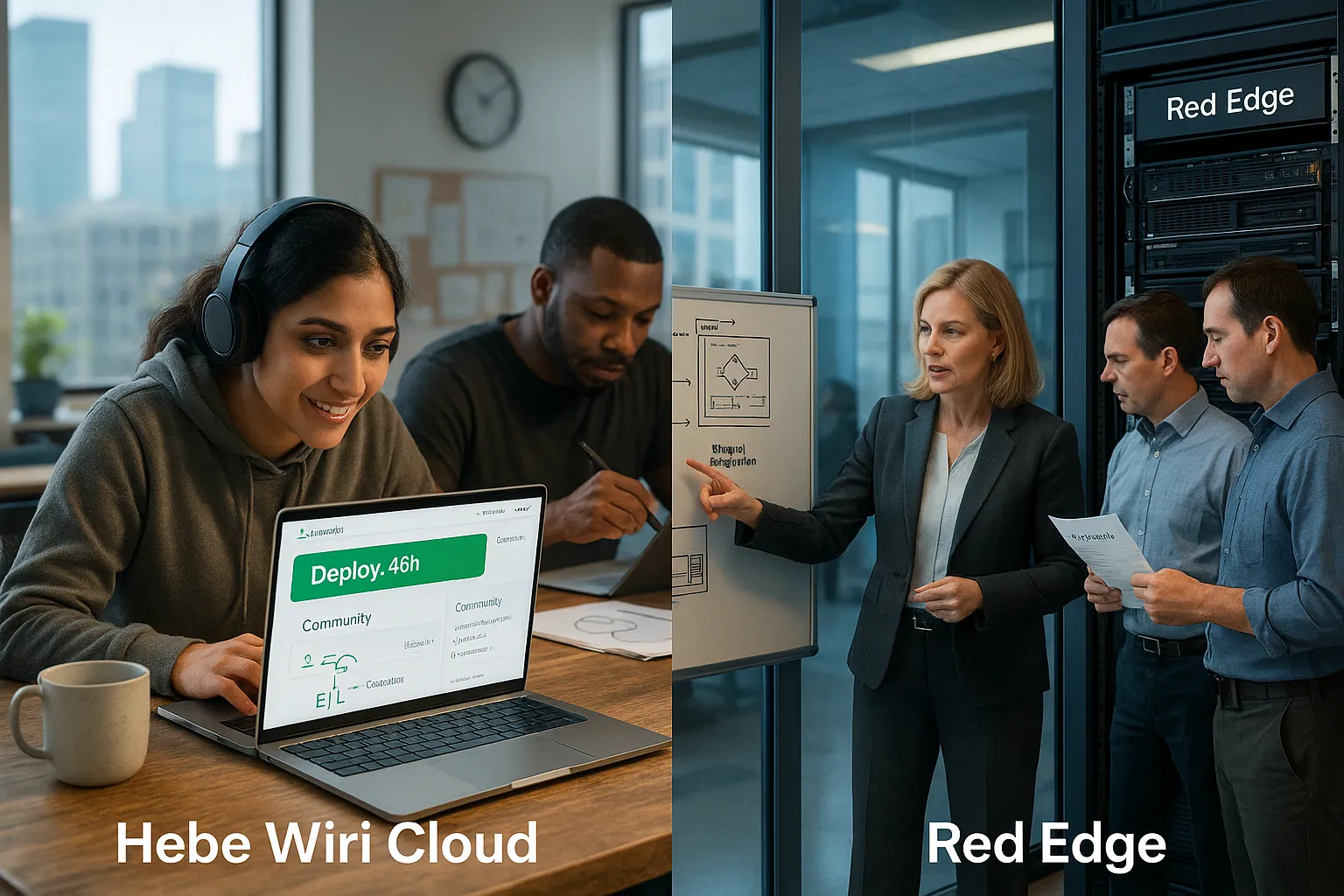
Fact: Hebe Wiri usually deploys faster: Red Edge requires more planning. Hebe’s managed stacks let teams go from zero to prototype in days. Red Edge deployments often involve network design, hardware, and compliance checks and can take weeks to months. If you have simple web apps, Hebe will get you live quickly. If you must integrate with mainframes or private networks, expect Red Edge to take longer.
Migration Tools, Data Portability, And Risk Mitigation
Fact: Both vendors offer migration tools: Red Edge emphasizes controlled migration. Hebe supplies data connectors, ETL helpers, and partner tools for lift‑and‑shift migrations. Red Edge provides controlled replication, staged cutovers, and rollback plans suited to mission‑critical systems. A real migration story: a retailer migrated its checkout system to Hebe in 48 hours with minor downtime. A bank migrated to Red Edge over a series of staged windows to preserve audit continuity.
Support Options, SLAs, And Community Resources
Fact: Red Edge includes enterprise SLAs: Hebe offers tiered support and active developer communities. Hebe has community forums, knowledge base articles, and paid premium support. Red Edge includes white‑glove onboarding, 24/7 enterprise support, and contractual SLAs with financial penalties for downtime. If you want community help and fast prototyping, Hebe’s developer ecosystem is stronger. If you need guaranteed response times and assigned engineers, Red Edge provides higher assurance.
Use Cases And Decision Guide: Which To Choose
Best Fit For Small And Medium Businesses
Fact: Hebe Wiri is usually the better fit for SMBs. You get lower startup costs, fast time to market, and developer productivity gains. Use Hebe for SaaS startups, content platforms, and apps that make use of public cloud services. If you value rapid iteration and fewer ops, pick Hebe.
Best Fit For Enterprises And Regulated Industries
Fact: Red Edge is usually the better fit for enterprises with strict compliance needs. Use Red Edge for banks, hospitals, and government agencies that require on‑prem options, deep audit logs, and guaranteed SLAs. If compliance, long retention, and deterministic performance matter, pick Red Edge.
Criteria To Prioritize Based On Your Needs
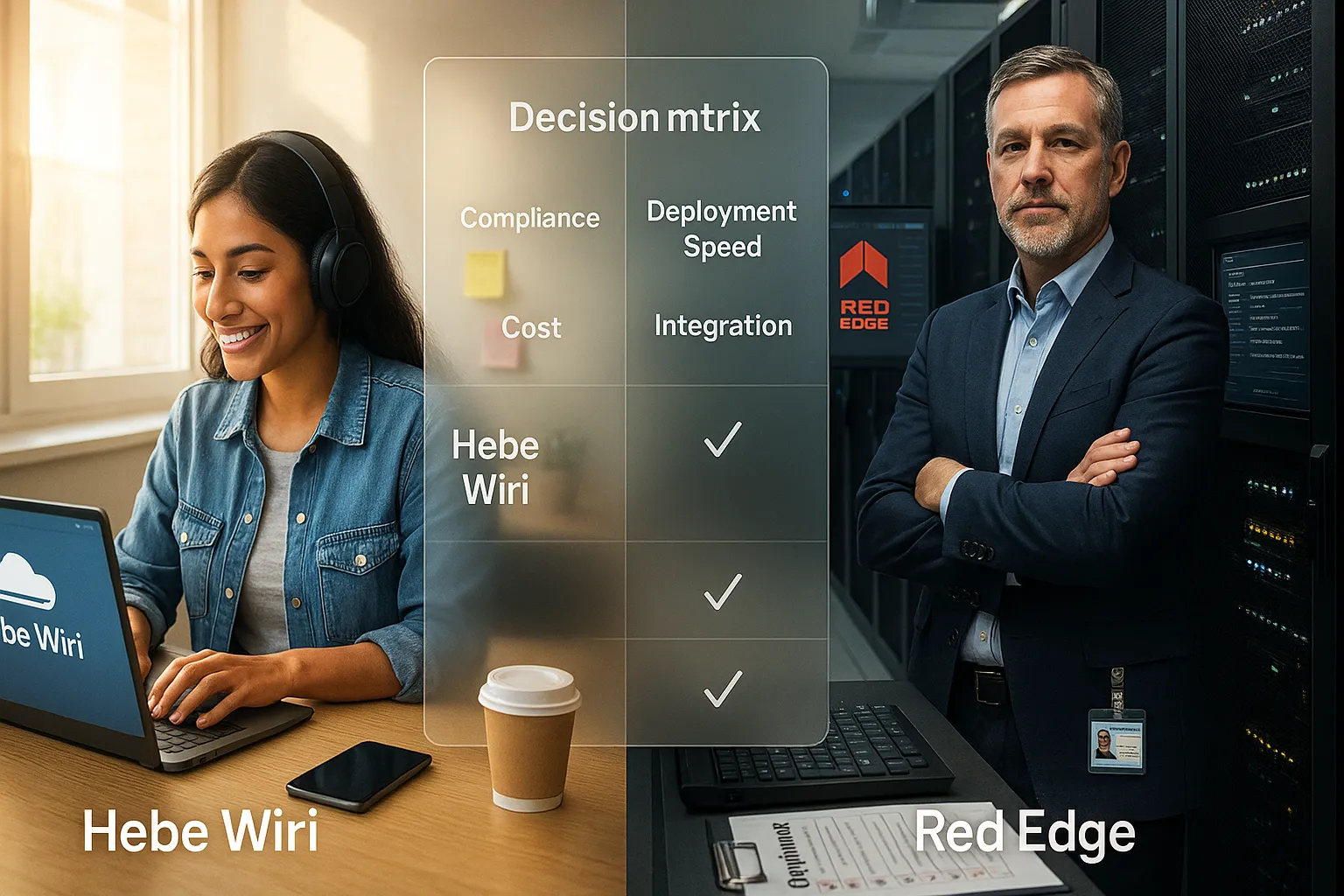
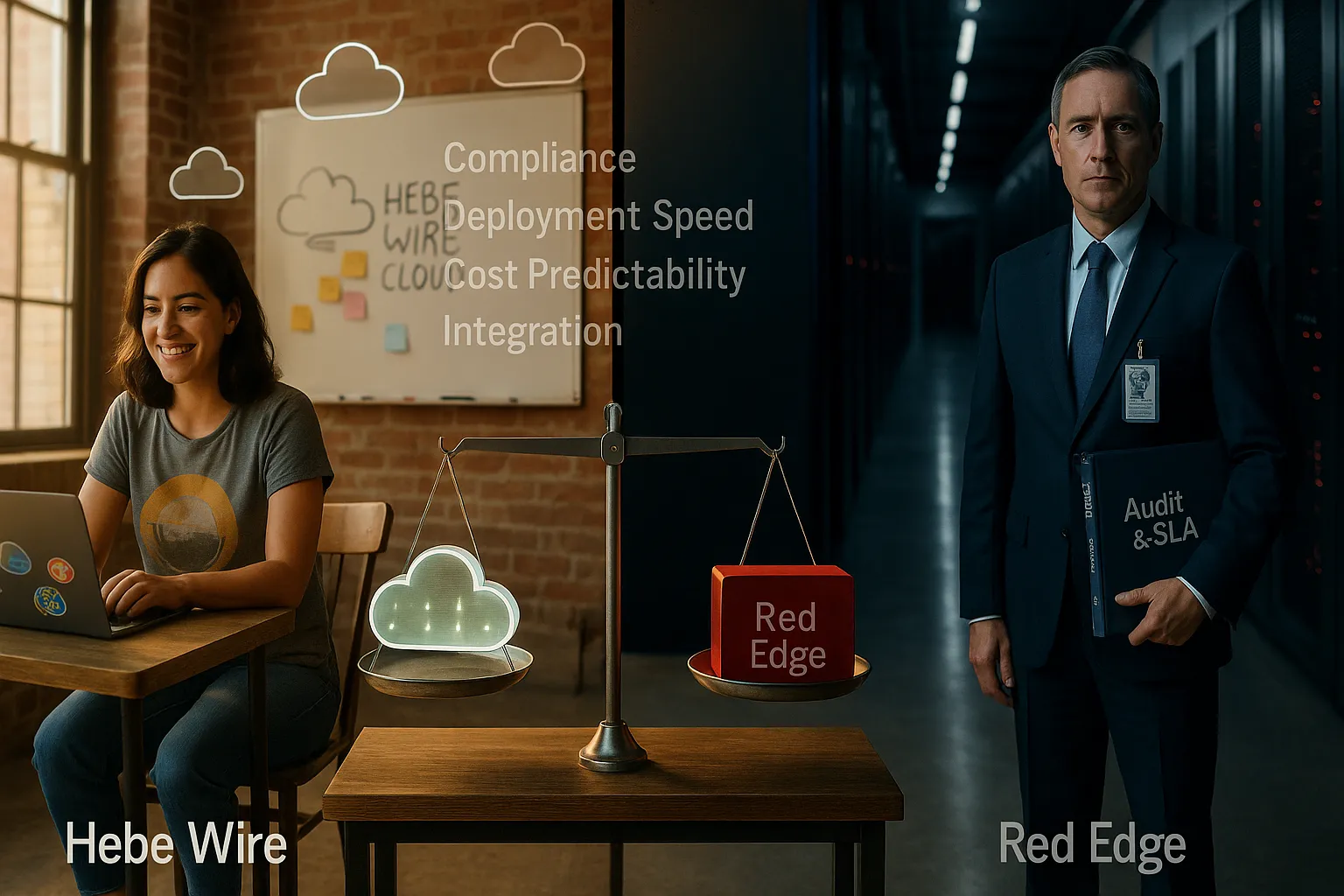
Fact: Prioritize these criteria: compliance, deployment speed, cost predictability, and integration needs. If compliance ranks highest, choose Red Edge. If speed and lower initial cost rank highest, choose Hebe. If integration with legacy systems is essential, favor Red Edge. If developer experience and cloud-native features matter most, favor Hebe.
How To Evaluate Both Platforms In A Pilot
Evaluation Checklist And Success Metrics For Pilots
Fact: A pilot should measure performance, cost, security posture, and developer productivity. Use this checklist:
- Baseline metrics: latency (p99/p95), throughput, error rate.
- Cost burn: monthly compute, storage, and egress for pilot workloads.
- Security checks: encryption at rest, RBAC effectiveness, audit log completeness.
- Migration test: full data import and rollback exercise.
- Developer velocity: time to deploy a change, number of failed deploys.
- Support responsiveness: time to first response and issue resolution.
Define success metrics upfront (e.g., p95 latency < 200 ms, deployment time < 10 minutes, security audit pass) and run the same workload on both platforms.
Questions To Ask Vendors During Demos And Trials
Fact: Ask specific operational and contractual questions. Here are high‑value questions:
- What exact SLAs do you guarantee, and what penalties apply on breach? (ask Hebe Wiri Cloud and Red Edge Inc.)
- How do you handle data egress and what costs apply?
- Can you show an architecture diagram for hybrid deployments?
- What migration tools and rollback procedures do you provide?
- How do you manage key rotation, HSMs, and tenant isolation?
- What monitoring and tracing stacks do you support (e.g., Prometheus, Jaeger, Splunk)?
- Who will my support contact be during onboarding and after?
Ask vendors to run a short live test during the demo: create a sample app, simulate load, and show logs and traces. That live exercise exposes gaps quickly.
You will find one platform better suited after testing these items. Trust your pilot data and the teams who must operate the system, not vendor sales claims.

- Micro-Clover vs. Grass: Which Groundcover Is Right For Your Lawn? - March 24, 2026
- Best Alternatives to Robinhood - March 24, 2026
- Olive Oil Alternatives: When Olive Oil Is the Wrong Tool, and What to Use Instead - March 23, 2026
by Ellie B, Site Owner / Publisher