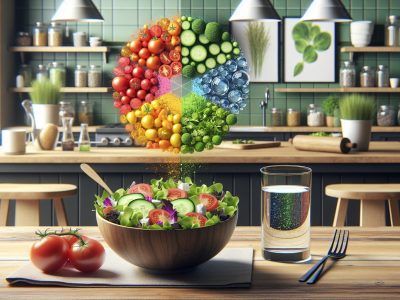
Picture peering into a glass of lemonade on a scorching afternoon—crystals of sugar swirling, slices of lemon drifting, sunlight catching every golden fleck. Now picture a perfectly blended milkshake where every sip tastes exactly the same. These everyday moments hide a fascinating secret about the world around you: not all mixtures are created equal.
You might think mixing is simple, but the difference between heterogeneous and homogeneous mixtures shapes everything from your favorite snacks to the air you breathe. Unlocking these differences can help you spot hidden patterns, make smarter choices in the kitchen, and even see science in a whole new light. Ready to see the world’s ingredients with fresh eyes?
Understanding Mixtures: Heterogeneous vs. Homogeneous
You look at your breakfast table and what do you see? Maybe a glass of orange juice with pulp—tiny suspended bits swirling in sunlight, never quite blending in—or a tall, clear glass of tap water, smooth as a mirror and always the same, top to bottom. Mixtures like these, so common yet so different, come with their own grammar in science. Heterogeneous mixtures like trail mix, granite, or soil keep their visible components separate, you could even pick out the pieces if you wanted. In contrast, homogeneous mixtures—hosing down thirst with saltwater or skim milk—showcase perfect blending, with every drop or pinch delivering the same flavor and appearance.
Chemists, when talking about heterogeneity, look for visible boundaries or clues in texture—think muddy river water compared to pure seawater. Do you wonder what happens if you stir sand with water, then let it sit? The sand settles, stubbornly refusing to blend—a scene straight from a child’s beach day. Solutions like steel or air, though weirder, fit neat into the homogeneous category since their particles of elements or compounds (iron and carbon in steel, nitrogen and oxygen in air) meld at the molecular level, appearing uniform no matter how close you look.
Ask yourself, how do these differences drive choices in your kitchen, lab, or garden? When you shake a bottle of salad dressing—oil and vinegar recoiling from each other—you’re battling nature’s tendency toward heterogeneity. Meanwhile, when tasting instant coffee, there’s not a single swirl, just smoothness throughout—a humble showcase of homogeneity. The line between the two isn’t always sharp either: milk, an everyday staple, sits on the borderline, with fats suspended in water but appearing fairly uniform (source: American Chemical Society).
Is it possible for a mixture to switch teams? Under your microscope, you’d see mayonnaise turn from an unstable blend of oil and egg yolk into a seemingly smooth, homogeneous spread—thanks to the molecular handshake called emulsification. These transformations unlock possibilities in food science and medicine, like creamy lotions or lifesaving IV fluids.
So, next time you scoop gravel for your garden or sip juice with or without pulp, you’re not just enjoying a moment, you’re interacting with concepts that shape industries, health, and daily experience. Will you look at your next glass, bowl, or plate and notice the chemistry at play?
Key Characteristics of Homogeneous Mixtures
Homogeneous mixtures show their unique nature through uniform composition and appearance. These mixtures don’t reveal their parts, even using a powerful microscope, which sets them apart in everyday science and kitchen chemistry.
Definition and Examples
Definition of homogeneous mixtures centers on their even distribution of components at the molecular level. You find no layers, flecks, or settling in a true homogeneous mixture, only one smooth phase. Saltwater stands out—salt dissolves fully in water, so every sip tastes the same. Air qualifies as well, since its oxygen, nitrogen, and trace gases mix so thoroughly they become visually and physically indistinguishable. Stainless steel, often overlooked, combines iron, carbon, and chromium for seamless uniformity, making your kitchen cutlery a silent member of the homogeneous family.
Examples you encounter daily include vinegar, soda (before it loses its fizz), and even mouthwash. When you pour vinegar into oil, the layers stay separated—classic heterogeneous behavior—but stir just sugar into water and you get something that looks as clear as glass.
Properties and Applications
Properties of homogeneous mixtures involve not just uniformity but also stability—if left alone, these mixtures maintain their sameness over time. No visible separation occurs, even under a microscope; that’s a test anyone with basic science gear can try. Industries depend on this consistency, as pharmaceutical companies require every dose of medicine to be identical, every batch of saline to hold the same salt concentration, and every bottle of ink to flow with predictable color.
Applications span far, from the food industry’s reliance on homogeneity for beverages and sauces, to the realm of electronics where conductive alloys require absolute evenness. Science teachers use dye and water to show that, with proper mixing, the dye disappears visually, challenging students to figure out where it went (try looking at it through a prism—the color’s everywhere). Do you ever ask yourself how perfumes spread their scent evenly in air or why you never see sugar in your sweetened tea? Homogeneous mixtures create these everyday wonders, even though—they rarely get noticed for them.
Key Characteristics of Heterogeneous Mixtures
Heterogeneous mixtures display a patchwork of different substances, where separate parts remain visible and distinct. You can easily spot their unique traits by looking for boundaries or tiny clumps suspended in a liquid or solid phase.
Definition and Examples
Heterogeneous mixtures are defined by their non-uniform composition—visible differences persist from one part to another. You encounter these mixtures daily. For example, you can notice chocolate chip cookies (chocolate chips embedded in dough), salad dressings with oil floating over vinegar, and rocky soil. Italian salad dressing, trail mix, or granite countertops all show a mixture where individual components retain their own identity. When you see orange juice with pulp, cereal in milk, or mixed nuts, you’re witnessing heterogeneity up close. Unlike homogeneous mixtures, separating these parts by hand, filtering, or decanting is possible.
Properties and Applications
Properties of heterogeneous mixtures include distinct phases, variable compositions, and visible boundaries between different particles or substances. You often find these mixtures in scenarios where components serve separate roles—think gravel in concrete, fruit pieces in yogurt, and soil layers in geologic samples. Scientists use microscopy and particle size analysis to classify heterogeneity in samples, according to the American Chemical Society. In the food industry, manufacturers design products like chunky salsas or vegetable soups for a textured sensation. Construction materials like asphalt and terrazzo leverage non-uniformity for structural strength and aesthetics. Even in medicine, blood is a heterogenous mixture, with plasma, red cells, and platelets maintaining visible separation under a microscope. Heterogeneous mixtures don’t stay uniform overtime, so sometimes separation can occur, like oil and water layers after sitting undisturbed.
By recognizing these key characteristics and examples, you better connect the basics of chemistry with the items and environments that surround you.
Main Differences Between Heterogeneous and Homogeneous Mixtures
Spotting the difference between heterogeneous mixtures and homogeneous mixtures shapes how you see everything from your kitchen to your classroom. Each type of mixture shows unique visual cues and properties, changing how you handle, separate, or even taste them.
Composition and Appearance
Recognizing composition and appearance, you instantly see why these mixture types feel like night and day. Heterogeneous mixtures, such as gravel in a fish tank or a pizza topped with olives and peppers, expose a mosaic of ingredients. You’re able to point to each part, and the boundary between pepperoni and melted cheese never blurs. Homogeneous mixtures, on the other hand, hide every trace of separate components—think of tap water running clear or sterling silver jewelry gleaming with uniform luster.
Chemists use terms such as phase and interface to talk about how parts of a mixture meet or mix. Visible phases pop up in granite, where flecks of black mica, pink feldspar, and white quartz tell stories of geological timelines. Homogeneous mixtures whisper secret uniformity at every level, with particles so even, not even a microscope can spot differences. The glass of cola you sip looks as smooth at the top as it does at the bottom. Researchers at the Royal Society of Chemistry confirm that visual uniformity marks a homogeneous blend, while patchiness hints at heterogeneity. why your orange juice taste pulpy at one sip and smooth at another? It’s the boundary in orange juice with pulp, a classic example of a heterogeneous drink, that draws sensory contrast. For homogeneous mixtures, such as sports drinks, not a drop looks or tastes out of place.
Separation Methods
Choosing a method for separation often depends on what kind of mixture you’ve got in your hands. You can pick marbles from a sandbox, filter salad dressing, or wait for muddy water to settle—heterogeneous mixtures let you physically spot differences and act on them. Tools include sieves, tweezers, and decanting. Sand in water, for instance, separates cleanly when left to stand, thanks to gravity.
Homogeneous mixtures mask their complexity, so you reach for methods less obvious. Salt dissolved in water needs evaporation or distillation to let pure crystals form again. No strainer finds the salt—it’s vanished at the molecular level. The American Chemical Society points out that separation of homogeneous mixtures often calls for changes in physical states or properties, such as boiling or freeze-drying, turning chemistry class into a puzzle hunt.
Picture looking at a batch of beach sand—who’d think, at a glance, that you could just swirl away the lighter shells while heavier grains sink? Now, compare that to separating cream from milk, where centrifugation, a spinning technique, exploits density—a glimpse into how seemingly simple substances challenge you with both art and science.
When next you pour yourself a glass of lemonade, ask: Is this blend a puzzle of ingredients or a seamless solution? By using your senses and a bit of critical thinking, you’re decoding the world’s mixtures, one glass and grain at a time.
Real-Life Examples and Use Cases
Picture you’re stirring a big glass of lemonade with sugar and water. If you see crystals twirling at the bottom, you’re not just making a drink—you’re witnessing a heterogeneous mixture play out in real time. It’s like watching a city, where every area stays a little unique—sugar hanging on while water flows everywhere. Now, think of adding syrup to your morning coffee. The transformation feels almost magical, doesn’t it? Even though the swirl, no matter how long you watch, it stays evenly dark and sweet—a homogeneous mixture, as consistent as a clear blue sky stretched across noon.
Families encounter heterogeneous mixtures daily. For example, your favorite trail mix, packed with almonds, raisins, and chocolate chips, always delivers a surprise in every handful. You pick what you want—no two bites are ever exactly alike. Compare that to a can of soda, where every swallow tastes the same, thanks to carbonation and dissolved sugars creating a perfect homogeneous solution.
Let’s step into industry. Asphalt, the stuff holding your neighborhood streets together, is a classic heterogeneous mixture. Rocks and tar form a gritty mosaic, vital for endurance against traffic (U.S. Department of Transportation, 2023). On the other hand, stainless steel (combining iron, chromium, and nickel) powers everything from skyscrapers to kitchen knives. Its atoms distribute so evenly that every slice of your chef’s knife could tell the same story (ASM International, 2021).
Ever wondered why salad dressings have “shake well before use” on the label? Oil and vinegar, left alone, split apart—a textbook heterogeneous combo. Meanwhile, pharmaceutical syrups provide homogeneous consistency, guaranteeing each spoonful delivers exact medication doses—life-saving reliability a matter of chemistry (FDA, 2022).
Consider what would happen if water for brewing beer wasn’t uniform. Breweries rely on homogeneous mixtures so every glass tastes identical, batch after batch. A slip—say, using untreated, mineral-heavy water—could crash the taste. Crafting paint, bakers, and even you with your next recipe, all depend on understanding these simple mixed moments.
So next time you reach for punch at a party or eye the layers forming in your favorite jar of salsa, ask yourself: What kind of mixture am I really looking at? Following the trail of mixtures from your kitchen to your street corners reveals chemistry’s hidden fingerprints in your day-to-day world. Maybe, there’s a new way to look at what’s in your glass, your lunchbox, or the sidewalks beneath your shoes.
Conclusion
When you start noticing the differences between heterogeneous and homogeneous mixtures, you’ll see chemistry everywhere—from your breakfast table to your favorite gadgets. Understanding these concepts empowers you to make smarter choices in the kitchen, at the store, and even in your hobbies.
By paying attention to how substances mix and interact, you’ll gain a deeper appreciation for the science shaping your daily experiences. Next time you enjoy a meal or use a household product, take a moment to consider the fascinating mixture at work right in your hands.
To provide the best experiences, we use technologies like cookies to store and/or access device information. Consenting to these technologies will allow us to process data such as browsing behaviour or unique IDs on this site. Not consenting or withdrawing consent, may adversely affect certain features and functions.
Functional
Always active
The technical storage or access is strictly necessary for the legitimate purpose of enabling the use of a specific service explicitly requested by the subscriber or user, or for the sole purpose of carrying out the transmission of a communication over an electronic communications network.
Preferences
The technical storage or access is necessary for the legitimate purpose of storing preferences that are not requested by the subscriber or user.
Statistics
The technical storage or access that is used exclusively for statistical purposes.The technical storage or access that is used exclusively for anonymous statistical purposes. Without a subpoena, voluntary compliance on the part of your Internet Service Provider, or additional records from a third party, information stored or retrieved for this purpose alone cannot usually be used to identify you.
Marketing
The technical storage or access is required to create user profiles to send advertising, or to track the user on a website or across several websites for similar marketing purposes.