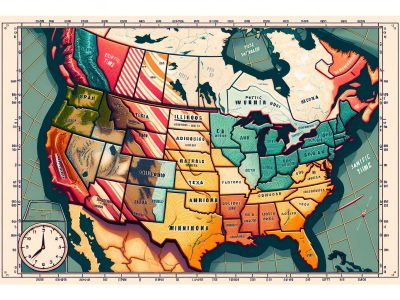
Ever found yourself puzzled by time zones, especially when it comes to EST and PST? You’re not alone. These abbreviations represent two of the four main time zones in North America and can cause quite a bit of confusion for those unfamiliar with them.
Understanding Time Zones
To clear the confusion surrounding Eastern Standard Time (EST) and Pacific Standard Time (PST), it’s crucial to first comprehend what time zones are, how they came into existence, and why they’re important in our daily life.
Brief Overview of Time Zones
Time zones refer to regions on Earth that have the same standard time. They were established following a system proposed by Sir Sandford Fleming in 1879, where he divided the world into 24 equal parts – each representing one hour. Now imagine this: It’s midnight at Greenwich Meridian (0° longitude); as you move westwards across different longitudes till you hit roughly 15° West; here it would be exactly an hour behind or simply put –11 PM! That is precisely what happens when we talk about EST and PST!
Eastern Standard Time (EST): An In-Depth Look
Diving deeper into the concept of time zones, let’s take a detailed look at one: The Eastern Standard Time (EST).
What is EST?
Eastern Standard Time, often abbreviated as EST, represents the standard time in use on the eastern coast of North America. It’s primarily observed during fall and winter months when Daylight Saving isn’t active. During this period, clocks are set back by an hour to give an extra hour of daylight.
To paint you a clearer picture – if it’s 12 noon according to Greenwich Mean Time (GMT), which acts as our universal reference point for global timescales – then it’d be 7 AM in areas operating under EST. This calculation follows from GMT subtracting five hours–a useful tidbit should you find yourself scheduling cross-time-zone calls or flights!
Regions Operating under EST
Now that we’ve demystified what EST is exactly, where does its influence reach? Quite far indeed! Areas observing Eastern Standard Time span across numerous U.S states and Canadian provinces.
In terms of American regions following this timezone protocol include large parts such as New York City; Washington D.C.; Atlanta Georgia; Miami Florida; Boston Massachusetts among others with some exceptions along state borders. Canada also has several regions abiding by these temporal rules including Ontario province except Northwestern region part plus most parts Quebec excluding East Coast area near Newfoundland Labrador border line likewise Nova Scotia territory.
Pacific Standard Time (PST): An In-Depth Look
After delving into the Eastern Standard Time, let’s switch our focus to its western counterpart – The Pacific Standard Time. This section dives deep into understanding what PST is and identifies regions operating under it.
What is PST?
Pacific Standard Time, or simply referred as PST, represents the time zone used on the west coast of North America during non-daylight saving months. Unlike EST which falls five hours behind GMT, this timezone sits eight hours behind Greenwich Mean Time (GMT). Think about scheduling a conference call between Los Angeles (operating under PST) and London – if it’s noon in London then it would be 4 am in LA due to this time difference!
Regions Operating Under PST
The scope of areas following Pacific Standard Timespan encompasses vast territories across multiple countries. Primarily observed by states along the Western Coastline of United States like California, Washington State & Nevada; major cities including San Francisco and Las Vegas live according to these clock settings.
Besides northward up on American Continent you’ll find British Columbia province of Canada also aligns with PDT/PST timings except for few communities located near eastern border sharing their clock with neighboring Alberta province instead.
Key Difference Between EST and PST
Understanding the key difference between Eastern Standard Time (EST) and Pacific Standard Time (PST) involves more than just calculating a three-hour time gap. It’s crucial for effective communication, scheduling, business operations, or even planning a simple phone call with your family across states.
Time Gap Between EST and PST
When it comes to the raw numbers behind these time zones, EST is ahead of PST by exactly 3 hours. For instance, when it’s noon in New York City that operates under EST during non-daylight saving months; at the same moment on any given day out west in San Francisco running on PST will only be showing 9 AM on their clocks.
But there are certain conditions attached like daylight savings which may affect this standard timing rule. When Daylight Saving starts from second Sunday of March till first Sunday of November every year; then cities observing DST shift their clock one hour forward i.e., they lose an hour during start but gain back that lost hour when DST ends.
While dealing with such situations you need not worry about subtracting dates or considering leap years as they don’t come into play while dealing with hourly differences amongst various time zones.
Impact of The Difference In Business And Communication
This disparity isn’t just relevant for individuals who have loved ones scattered throughout different regions – businesses often rely heavily upon accurate knowledge about differing times. Consider if you’re handling international teleconferences involving team members from both coasts: knowing precisely how much earlier your East Coast colleagues begin their workday can prevent inadvertent late-night calls disrupting sleep schedules out West!
Considerations When Converting EST to PST
As you investigate into the world of time zones, converting between Eastern Standard Time (EST) and Pacific Standard Time (PST) becomes a critical skill. You’ll often encounter this conversion in professional settings, such as scheduling meetings or coordinating project timelines with team members across different locations.
Tools and Applications for Time Zone Conversion
In today’s digital era, numerous tools aid in swiftly converting EST to PST. These online platforms eliminate the need for manual calculation, so reducing potential errors.
World Clock: A comprehensive tool offering real-time updates on global times.
TimeAndDate.com: Besides conversions it provides countdowns, calendars & weather information.
Google Search Engine: Simply type ‘EST to PST’ in Google search bar – instant results are displayed.
Mobile Apps like WorldTimeBuddy: Convenient option when you’re on-the-go.
Ensure that your device has correct timezone settings while using these applications; incorrect configurations may lead to erroneous outcomes.
Best Practices When Dealing with Different Time Zones
When working across multiple time zones such as EST and PST:
Optimize communication timing: Avoid setting up meetings at inconvenient hours due their differing schedules,
Clearly communicate which time zone any given appointment is set within,
Keep track of Daylight Saving changes – they affect both timings by an hour each year,
Use technology tools mentioned above ensuring everyone stays aligned even though geographical disparities,
The Global Impact of Time Zones
Time zones, particularly Eastern Standard Time (EST) and Pacific Standard Time (PST), have more than just a domestic impact. They influence international relations and global events significantly.
How EST and PST Affect International Relations
In the area of international relations, understanding time differences between EST and PST is crucial. For example, when dealing with foreign trade or diplomatic communications involving countries across these two time zones such as United States-Canada collaborations in North America, precise timing can be critical for success.
Governments often schedule official meetings according to EST since many important cities like New York City or Washington D.C., operate on this standard during fall/winter months without daylight saving’s effect. Hence knowing that EST is five hours behind GMT ensures smooth coordination among parties involved globally.
On another hand, businesses operating under PST – eight hours behind GMT – must also factor in their schedules especially if they are collaborating with partners from other regions observing different times such as Asia or Europe.
For instance arranging conference calls require one to understand that noon at San Francisco means it’s already evening in London; adjusting accordingly prevents miscommunication due to inappropriate timings.
Further importance lies within legal proceedings where documentation timestamps become vital pieces evidence while decisions need synchronization across borders considering corresponding local times making knowledge about difference essential element successful collaboration internationally.
The Role of EST and PST in Global Events
Global events too aren’t immune from effects brought by time zone variations specifically those between eastern pacific standards ones some world’s most-watched happenings including Olympics Super Bowl scheduled keeping mind vast audiences spread over multiple territories hence organizers take into account prime viewing slots around globe which largely depends exact location event happening hence mastering conversion becomes imperative broadcasting companies wishing maximize reach viewership rates broadcast windows set favorably towards populated areas falling either these thereby enhancing experience millions tuning same moment even though geographical distances apart main broadcaster host nation reality television shows news programs live sports coverage only few examples where application comes into play.
For instance, if a global event is hosted in New York City (EST), broadcasters must calculate when to air the program in PST regions such as California or Washington for maximum viewership.
This interplay between EST and PST further extends to digital platforms like social media websites which see increased activity during these events due to live updates discussions taking place effectively making them virtual gathering spots users all over world hence understanding how time zones affect user engagement helps maximize reach effectiveness marketing campaigns promotional activities tied with major happening this sense mastering art conversion can become strategic tool achieving greater impact on international stage.
Conclusion
Understanding time zones, particularly EST and PST is crucial in today’s globalized world. You’ve learned that these two major North American time zones differ by three hours – with noon on the east coast translating to 9 AM on the west coast. This knowledge can significantly streamline your communication, scheduling efforts, and business operations across coasts.
You also know now how significant a role EST plays globally due to its widespread adoption for international dealings. On the other hand, businesses operating under PST must be mindful of their schedules when dealing with partners in different parts of the globe.
By mastering conversions between EST and PST using handy tools like World Clock or Google Search you’re more equipped than ever before for successful collaborations irrespective of geographical boundaries! Finally remember it’s not just about work: this understanding even enhances your enjoyment of global events as broadcasters calculate airing times based around these very same principles.
To provide the best experiences, we use technologies like cookies to store and/or access device information. Consenting to these technologies will allow us to process data such as browsing behaviour or unique IDs on this site. Not consenting or withdrawing consent, may adversely affect certain features and functions.
Functional
Always active
The technical storage or access is strictly necessary for the legitimate purpose of enabling the use of a specific service explicitly requested by the subscriber or user, or for the sole purpose of carrying out the transmission of a communication over an electronic communications network.
Preferences
The technical storage or access is necessary for the legitimate purpose of storing preferences that are not requested by the subscriber or user.
Statistics
The technical storage or access that is used exclusively for statistical purposes.The technical storage or access that is used exclusively for anonymous statistical purposes. Without a subpoena, voluntary compliance on the part of your Internet Service Provider, or additional records from a third party, information stored or retrieved for this purpose alone cannot usually be used to identify you.
Marketing
The technical storage or access is required to create user profiles to send advertising, or to track the user on a website or across several websites for similar marketing purposes.