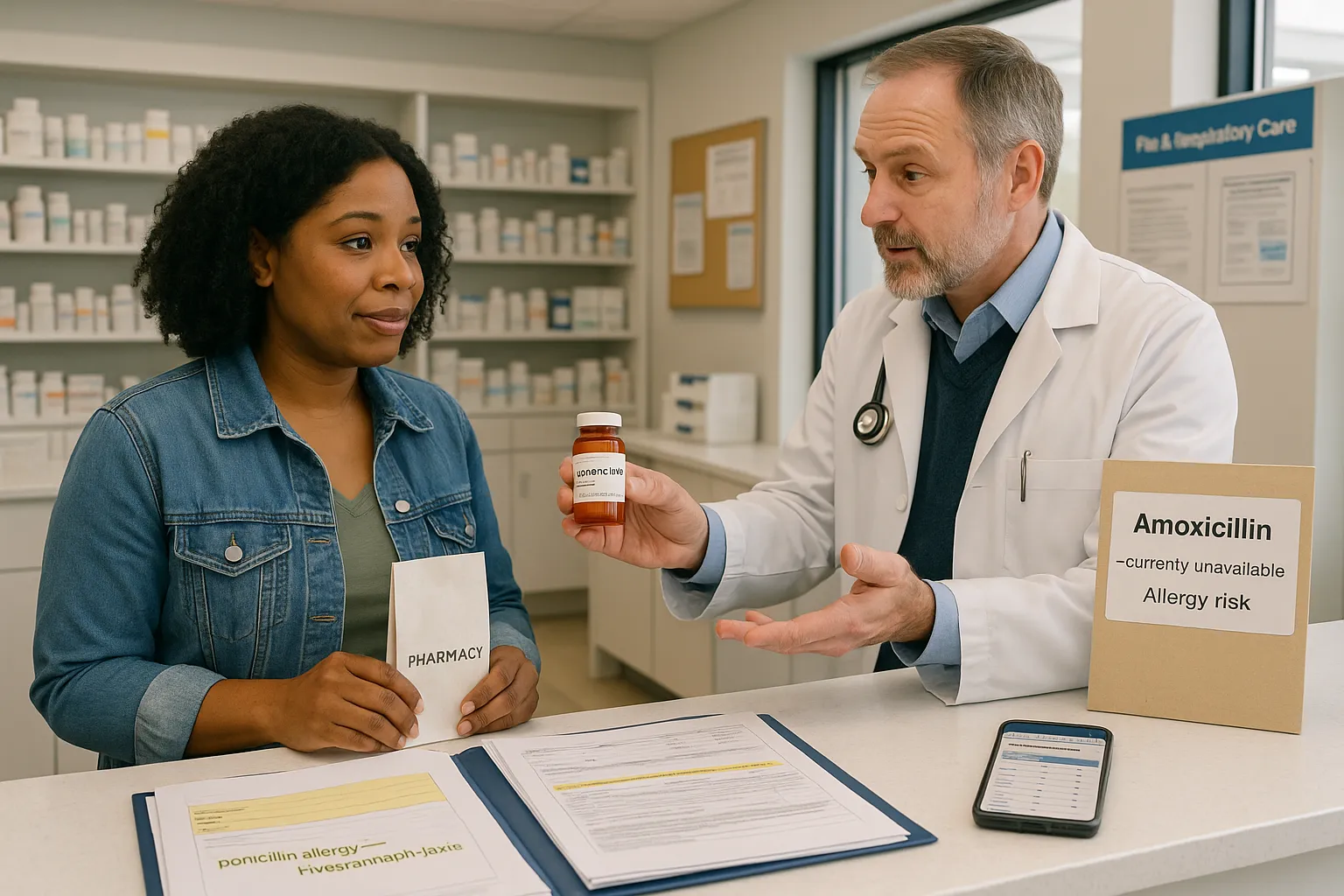
When you need an alternative to amoxicillin, the right choice depends on the infection, your allergy history, and local resistance patterns. Think of antibiotics like tools in a toolbox: some screwdrivers work for many screws, but a stripped screw needs a different head. You’ll learn practical options, what they treat, dosing ranges, risks, and when a clinician will pick one over another, so you can talk to your provider with clarity and confidence.
When A Substitute For Amoxicillin Is Needed
Fact: You need a substitute when amoxicillin is ineffective, unavailable, or unsafe for you. Common reasons include documented penicillin allergy, known resistance (for example with some H. influenzae or MRSA strains), recent treatment failure, or drug interactions.
If you have a history of hives, swelling, or anaphylaxis after penicillin, clinicians will avoid amoxicillin. Also, if you recently took amoxicillin for the same infection, bacteria may resist it. In some regions pharmacies run short, or your insurance prefers another agent. Mention any previous antibiotic failures and local data, for example, community rates of macrolide resistance, so your prescriber can make a better choice.
A note from experience: I once took a course of amoxicillin for sinusitis that didn’t help: the clinician switched to doxycycline and symptoms improved within 48 hours. That change mattered because the infecting bacteria was likely resistant to amoxicillin-clavulanate.
How Clinicians Choose An Alternative
Fact: Clinicians weigh infection type, allergy status, likely pathogens, severity, local resistance, and patient factors (age, pregnancy, kidney function).
First they identify the most likely bacteria. For strep throat, group A Streptococcus remains common. For uncomplicated UTI, E. coli is usual. Then they pick an antibiotic with activity against that pathogen and a dosing schedule the patient can follow. They check for allergies, drug interactions (for example, doxycycline with isotretinoin), and pregnancy status.
Clinicians also use rapid tests or cultures when needed. A rapid strep test or throat culture guides therapy for pharyngitis. Urine culture confirms UTI and refines therapy. When in doubt, they may start an empiric alternative, then adjust once lab results arrive.
Practical point: ask your clinician about local antibiograms or resistance trends. That data often guides whether they’ll use a macrolide, cephalosporin, or TMP-SMX.
Top Substitute Options And When To Use Them
Fact: Several drug classes commonly replace amoxicillin: selection depends on the infection.
Typical Uses, Dosing Considerations, Pros And Cons
Start with clear uses: beta-lactam allergy, resistance, and specific pathogen coverage. Dosing varies: some drugs need once-daily dosing (azithromycin), others require multiple daily doses (cephalexin). Pros and cons include coverage breadth, side effects, and cost.
Amoxicillin‑Clavulanate (Augmentin)
Fact: Amoxicillin-clavulanate expands amoxicillin’s activity against beta-lactamase producers. Use it for many sinus, ear, and dental infections when simple amoxicillin fails. Typical adult dosing: 500/125 mg twice daily or 875/125 mg twice daily: higher doses for severe infection. Pros: broader coverage. Cons: higher risk of diarrhea and Clostridioides difficile: not helpful with true penicillin anaphylaxis.
Cephalosporins (Cephalexin, Cefuroxime)
Fact: Cephalosporins cover many gram-positive and some gram-negative bacteria and are often safe for patients with non-severe penicillin allergies. Cephalexin dosing: 500 mg every 6–12 hours for adults: cefuroxime axetil: 250–500 mg twice daily. Pros: good for skin, soft tissue, and some respiratory infections. Cons: cross-reactivity in a small subset of patients with severe penicillin allergy: less effective against beta-lactamase producers unless you choose a higher-generation drug.
Macrolides (Azithromycin, Clarithromycin)
Fact: Macrolides target atypical pathogens and some streptococci: they’re useful when you can’t use beta-lactams. Azithromycin dosing: 500 mg day one, then 250 mg days 2–5 (typical). Pros: convenient dosing, covers atypicals like Mycoplasma. Cons: rising resistance among Streptococcus pneumoniae and S. pyogenes: drug interactions (clarithromycin with statins) and QT prolongation risk.
Tetracyclines (Doxycycline)
Fact: Doxycycline covers many respiratory pathogens, skin infections, and some sinusitis cases. Typical adult dose: 100 mg twice daily or 200 mg once daily. Pros: good for MRSA skin infections and atypicals: oral availability. Cons: contraindicated in pregnancy and young children due to tooth and bone effects: photosensitivity is common.
Trimethoprim‑Sulfamethoxazole (TMP‑SMX)
Fact: TMP‑SMX is effective for many skin and urinary pathogens, including some MRSA strains. Typical dosing for uncomplicated UTI: one double-strength tablet (160/800 mg) twice daily for 3 days. Pros: strong activity against many community MRSA and UTI isolates. Cons: not reliable for streptococcal pharyngitis: risk of allergic reaction, hyperkalemia, and skin reactions.
Fluoroquinolones (Levofloxacin, Moxifloxacin), When Reserved For Use
Fact: Fluoroquinolones have broad activity and are reserved for cases where safer alternatives fail or aren’t appropriate. Levofloxacin dosing: 500–750 mg once daily. Pros: excellent oral bioavailability and broad coverage. Cons: tendon rupture, CNS effects, and associations with aortic aneurysm risk: they should be last-line for uncomplicated infections.
Best Alternatives By Common Infection Type
Fact: The best substitute varies by infection, use the agent with proven activity against the likely pathogen.
Acute Otitis Media
Best substitute: amoxicillin-clavulanate or cefdinir/cefuroxime if amoxicillin fails or allergy exists. For penicillin allergy without anaphylaxis, cefdinir 300 mg twice daily is common. If severe penicillin allergy, azithromycin may be used though resistance is higher.
Streptococcal Pharyngitis (Strep Throat)
Best substitute: first-line remains penicillin or amoxicillin. If allergic, azithromycin or clarithromycin are typical alternatives. Note: TMP‑SMX is not effective for strep throat.
Acute Bacterial Sinusitis
Best substitute: amoxicillin-clavulanate is preferred when resistance or recent amoxicillin use is suspected. Doxycycline is an alternative for penicillin-allergic adults. For severe cases, ceftriaxone (IM) may be needed.
Uncomplicated Urinary Tract Infection
Best substitute: nitrofurantoin, TMP‑SMX, or fosfomycin depending on local E. coli resistance and patient factors. Nitrofurantoin 100 mg twice daily for 5 days is first-line for many women. Avoid nitrofurantoin in suspected pyelonephritis.
Dental Infections And Abscesses
Best substitute: amoxicillin-clavulanate or clindamycin for penicillin-allergic patients. Clindamycin 300 mg every 6–8 hours reaches oral anaerobes well but carries C. difficile risk.
Safety, Allergy, And Special Population Considerations
Fact: Allergy history, pregnancy, age, and comorbidities change safe choices.
Penicillin Allergy And Cross‑Reactivity With Cephalosporins
Clear answer: Most people with reported penicillin allergy can take cephalosporins safely if their reaction was mild. True IgE-mediated anaphylaxis is different: avoid cephalosporins if you had anaphylaxis. Recent studies place cross-reactivity around 1% or lower for modern cephalosporins.
Pregnancy, Breastfeeding, And Pediatric Considerations
Clear answer: Many alternatives are contraindicated in pregnancy. Cephalosporins (cefuroxime, cephalexin) and azithromycin are generally safer in pregnancy than tetracyclines or fluoroquinolones. Doxycycline is avoided. For children, dosing is weight-based: amoxicillin-clavulanate often remains first-line unless allergy exists.
Common Side Effects And Serious Adverse Reactions To Watch For
Clear answer: Expect GI upset, diarrhea, and rash with many antibiotics. Watch for severe reactions: anaphylaxis (hives, breathing difficulty), severe skin rash, or signs of C. difficile (severe watery diarrhea). Also monitor for tendon pain with fluoroquinolones and photosensitivity with doxycycline.
Antibiotic Stewardship And Resistance Concerns
Fact: Overuse of broad-spectrum antibiotics drives resistance: stewardship reduces harm.
You should use the narrowest effective antibiotic, for the shortest effective duration. For example, 5 days may suffice for uncomplicated UTI or acute otitis media in many cases. Avoid macrolides for respiratory infections where local resistance is high. Clinicians consult local antibiograms: you can ask for that data.
Resistance is not abstract: resistant E. coli make UTIs harder to treat, and MRSA changes skin infection choices. When antibiotics are overprescribed for viral infections, resistance grows. Be willing to accept watchful waiting for mild sinusitis or sore throat if testing suggests a viral cause.
When To See A Doctor Or Seek Urgent Care
Fact: Seek care if symptoms are severe, worsening, or accompanied by systemic signs.
Go to urgent care or ED for high fever, breathing difficulty, severe pain, swelling that impairs function, or signs of sepsis (rapid heart rate, low blood pressure, confusion). For worsening infections even though 48–72 hours of antibiotics, return for reassessment.
Questions To Ask Your Provider And What To Expect From Testing
Ask: “What is the likely cause?” “Is this bacterial?” “What are the pros and cons of this alternative?” “Are there lab tests you recommend?” Expect a targeted exam, possible rapid strep or influenza test, urine dip/culture, or bacterial culture from a wound. If your provider starts empiric therapy, they should advise when to follow up and what side effects to watch for.
Final practical tip: bring a list of current medicines, allergies, and any prior antibiotic failures. That will speed correct prescribing and reduce errors.
To provide the best experiences, we use technologies like cookies to store and/or access device information. Consenting to these technologies will allow us to process data such as browsing behaviour or unique IDs on this site. Not consenting or withdrawing consent, may adversely affect certain features and functions.
Functional
Always active
The technical storage or access is strictly necessary for the legitimate purpose of enabling the use of a specific service explicitly requested by the subscriber or user, or for the sole purpose of carrying out the transmission of a communication over an electronic communications network.
Preferences
The technical storage or access is necessary for the legitimate purpose of storing preferences that are not requested by the subscriber or user.
Statistics
The technical storage or access that is used exclusively for statistical purposes.The technical storage or access that is used exclusively for anonymous statistical purposes. Without a subpoena, voluntary compliance on the part of your Internet Service Provider, or additional records from a third party, information stored or retrieved for this purpose alone cannot usually be used to identify you.
Marketing
The technical storage or access is required to create user profiles to send advertising, or to track the user on a website or across several websites for similar marketing purposes.